Progress tracker
Each seedling gets an ID: P01, P02, P03 ... Write the ID on a small tag or a
painted stone next to the plant, so the plant in the garden and the row in this table are
always the same plant. If plants are handled as one group (same day, same fertilizer),
still log each ID so a single sick plant can be followed later.
Plants
| ID | Type | Bought on | From | Planted on | Place in the garden | Status |
|---|---|---|---|---|---|---|
| P01 | PP PB (ordinary) | 2026-08-31 | Coconut Cultivation Board, Eraminigolla | 2026-09-08 | Closest to the main concrete road | planted |
| P02 | PP PB (ordinary) | 2026-08-31 | Coconut Cultivation Board, Eraminigolla | 2026-09-08 | Near mother's home, by the side of the road to mother's house | planted |
| P03 | PP PB (ordinary) | 2026-08-31 | Coconut Cultivation Board, Eraminigolla | 2026-09-10 | Close to Asanka's house and to the concrete road | planted |
Status values: in polybag, planted, growing, sick, dead.
Event log
Newest entry at the bottom. One row per action, per plant or per group.
| Date | Plants | Action | Details |
|---|---|---|---|
| 2026-08-31 | P01, P02, P03 | Bought | 3 seedlings, 550 each, receipt no. 1222070. See Costs. |
| 2026-09-05 | P01, P02, P03 | Bought | Compost fertilizer, one 40 kg bag, 1,500. See Costs. |
| 2026-09-07 | P01, P02, P03 | Bought | About 300 coconut husks from Anuradha, 1,000 with the transport. See Costs. |
| 2026-09-07 | P01, P02 | Hole dug | Excavator, 1.5 hours at 3,300/h. Holes are 4 x 4 feet. See Costs. |
| 2026-09-08 | P01, P02 | Fertilizer | More than 20 kg of compost per hole, mixed into the fill. YPM and dolomite also mixed in — the layers are different for each plant, see How the holes were made and filled. |
| 2026-09-08 | P01, P02 | Planted | Planted in the prepared holes. See Photos. |
| 2026-09-08 | P01 | Mulching | Ring of coconut husks around the plant. |
| 2026-09-08 | P02 | Mulching | Dry banana leaves around the plant. |
| 2026-09-08 | P01, P02 | Other | Cut plastic barrel put around each plant as a guard, dug 2-3 inches into the soil. |
| 2026-09-09 | P01, P02, P03 | Bought | 200 feet alkathene pipe (4,800) and sockets and fittings (4,235) for the waste water line. See Costs and Watering with waste water. |
| 2026-09-10 | P03 | Fertilizer | Dolomite, YPM and compost mixed into the top 4 to 6 inches of soil only. Amounts not recorded. See How the holes were made and filled. |
| 2026-09-10 | P03 | Planted | Hole about 3 feet deep, so only 2 layers of coconut husks. Gravel soil with many more rocks than the other two holes. |
| 2026-09-16 | two next plants (not bought yet) | Bought | YPM-W 2.5 kg (550), dolomite 2 kg (40) and a second 40 kg compost bag (1,500). The YPM and dolomite are exactly the per-hole amounts from the guide, for 2 holes. See Costs. |
Action values: Bought, Hole dug, Planted, Fertilizer, Watering, Mulching,
Pest / disease, Measured, Other.
For a Fertilizer row, always write in Details: which fertilizer, how much per plant,
and how it was applied.
Photos
P01 — planted 2026-09-08
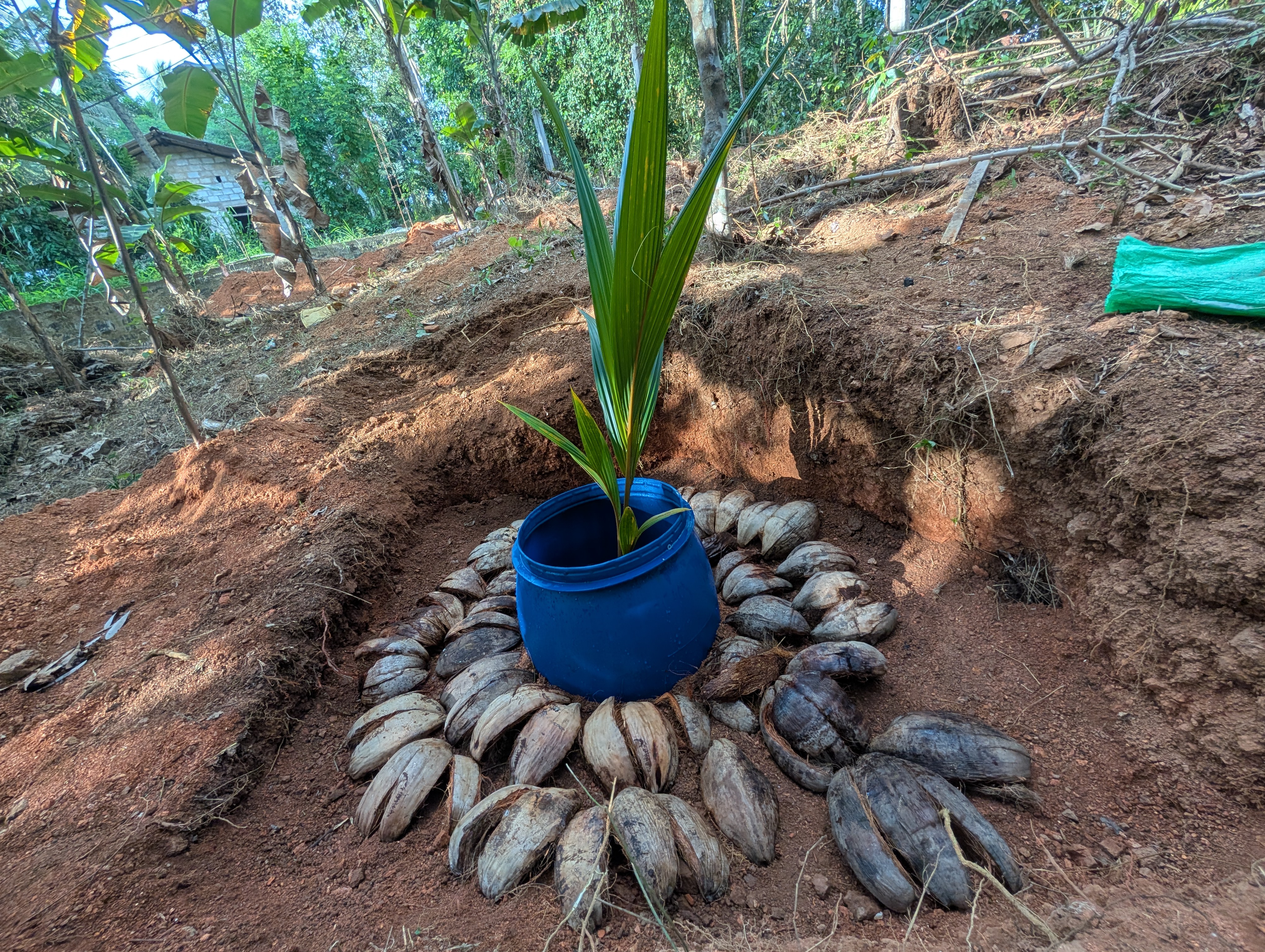
The seedling closest to the main concrete road, on the cut slope. Mulched with a ring of coconut husks.
P02 — planted 2026-09-08
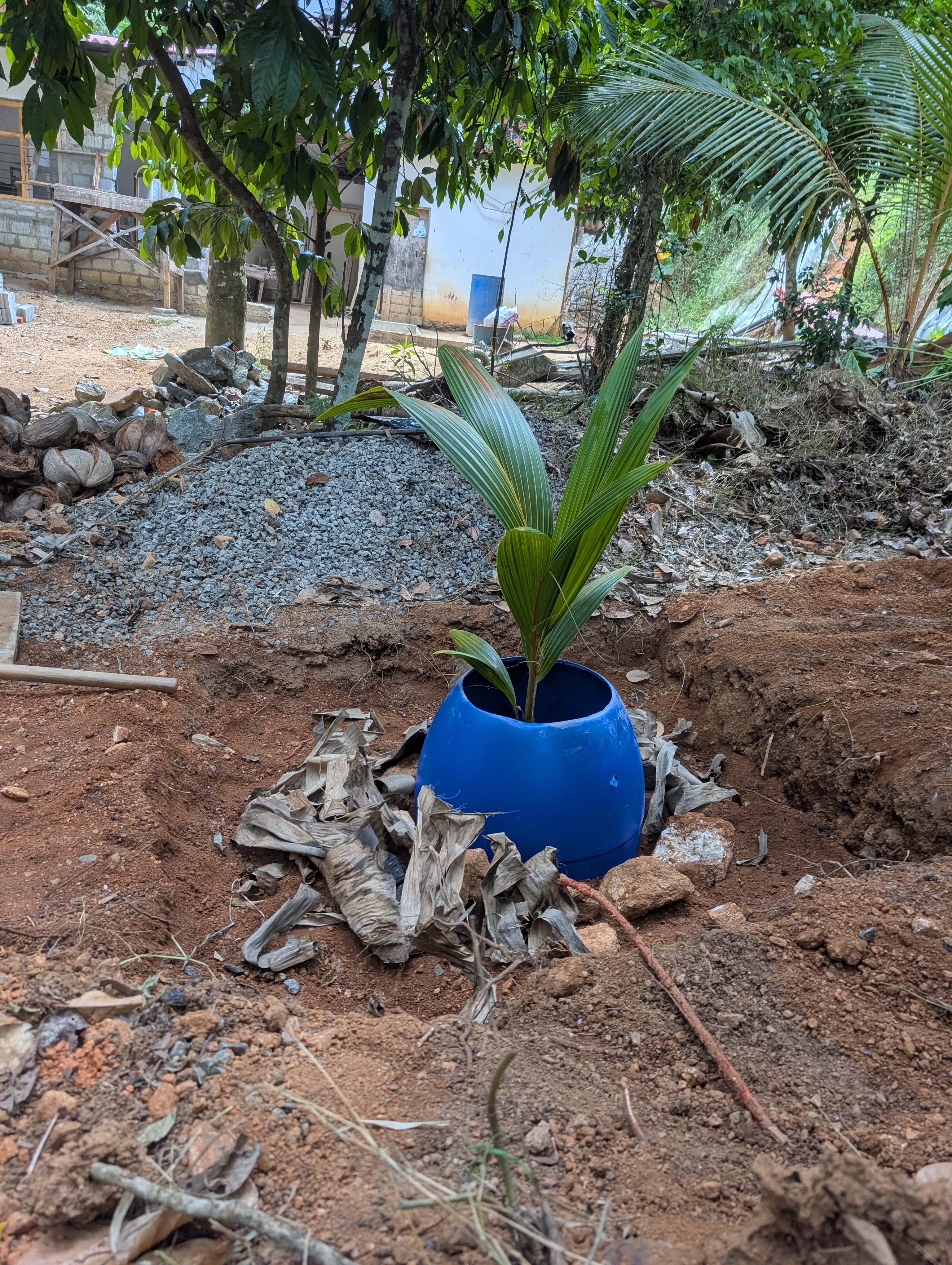
The seedling near mother's home, by the side of the road to mother's house. Mulched with dry banana leaves.
How the holes were made and filled
This is what was actually done, which is not the same as the guide in Planting of coconut seedlings.
Same for the P01 and P02 holes:
- Hole size: 4 x 4 feet.
- 3 layers of coconut husks (the guide says 2).
- More than 20 kg of compost per hole (the guide says 10 kg to 12 kg).
- Old grass that was removed from the land was put on top of the coconut husks, as a filler. This means less soil has to go back into the hole.
- Only 2 seedlings could be planted in one day. Plan one more day for
P03.
Where the YPM and dolomite went:
| Plant | Layer that got YPM + dolomite | Depth of that layer from the top |
|---|---|---|
| P01 | top 4 to 6 inches | at the top |
| P02 | about 8 inches thick | starts about 1 foot down from the top |
| P03 | top 4 to 6 inches (compost too) | at the top |
For P02, a mix of bottom soil and compost was put on top of the YPM + dolomite layer.
The P03 hole (planted 2026-09-10) was different:
- Depth: about 3 feet, so there was room for only 2 layers of coconut husks.
- Dolomite, YPM and compost went only into the top 4 to 6 inches of soil.
- The gravel soil had many more rocks than the
P01andP02holes.
Barrel guard
A cut plastic barrel was put around each seedling to protect it from wild pigs and
porcupine (ඉත්තෑවා). The barrel could only be dug 2-3 inches into the soil. It is not
known yet if this is deep enough — the animals may push it over or dig under it.
Check the barrels after every animal visit and write what happened in the Event log. If 2-3 inches is not enough, the options are to dig the barrel deeper or to put stones around its base.
Watering with waste water
The plan is to water the plants with the waste water from the bathroom and the kitchen, instead of carrying water by hand. This is grey water, not toilet water.
Bought for it on 2026-09-09 (see Costs):
- 200 feet of alkathene pipe — 4,800
- sockets and other fittings — 4,235
Not done yet: the pipe is not laid and the line is not connected.
Things to keep in mind when the line is laid:
- Send the water to the mulch ring around the plant, not straight onto the stem.
- Kitchen water carries oil and food bits. It can block the pipe. Plan a simple trap or filter that can be cleaned.
- Soap and detergent water is not good for the plant in large amounts. Ask the Coconut Development Officer (see Contacts) how much is safe.
- Do not let water stand around the plant. Standing water rots the roots and breeds mosquitoes.
Growth measurements
Measure every 3 months. It shows if a plant is doing badly before it looks bad.
| Date | Plant | Height (cm) | Number of leaves | Notes |
|---|---|---|---|---|
Next actions
| Due | What | Plants | Done on |
|---|---|---|---|
| before planting | Dig the holes and fill them — see Planting of coconut seedlings | P01, P02, P03 | 2026-09-07 for P01, P02; by 2026-09-10 for P03 |
| as soon as possible | Plant the seedlings and add mulching | P01, P02, P03 | 2026-09-08 for P01, P02; 2026-09-10 for P03 |
| as soon as possible | Dig the hole, plant P03 and add mulching. Keep one full day for it — only 2 plants fit in a day | P03 | 2026-09-10 |
| if not done at planting | Mulch P03 and put a barrel guard around it, then add a row to the Event log | P03 | |
| after the next animal visit | Check if the barrel guard at 2-3 inches deep holds against wild pigs and porcupine | P01, P02 | |
| every few days until the plant settles | Water the seedlings | P01, P02, P03 | |
| next few weeks | Watch P03 closely — shallower hole, fertilizer only in the top 4 to 6 inches, and rocky gravel soil | P03 | |
| as soon as possible | Lay the 200 feet alkathene pipe and connect the bathroom and kitchen waste water line — see Watering with waste water | P01, P02, P03 | |
| as soon as possible | Buy the 2 more seedlings the YPM-W, dolomite and second compost bag were bought for, then give them IDs P04 and P05 in the Plants table | P04, P05 | |
| before the next planting | Write down the shop name for the YPM-W, the dolomite and the second compost bag | - | |
| when the line is laid | Ask the Coconut Development Officer how much soap and detergent water is safe for a young palm | - | |
| at planting | Ask the Coconut Development Officer for the fertilizer schedule for the first years, and write it in the section below | - | |
| at planting | Use the 40 kg compost bag when filling the holes, and write the amount used per plant in the Event log | P01, P02, P03 | 2026-09-08 for P01, P02 |
| before planting P03 | Check what is left of the compost and the 300 coconut husks. Each hole took more than 20 kg of compost and 3 layers of husks | P03 |
When an action is done, put the date in Done on, add a row to the Event log, and add the next action here. If the status of a plant or the next step changed, update the table in the section landing page too.
Fertilizer plan
Not confirmed yet. Ask the Coconut Development Officer (see Contacts) or the Eraminigolla office for the correct schedule for a young palm, then fill this table.
| Age of plant | When | Fertilizer | Amount per plant |
|---|---|---|---|
Rule to follow: apply fertilizer when the soil is wet (with the rain), never on dry soil.
After each application, add a Fertilizer row to the Event log and put the next date
in Next actions.